
Application of Lean Principles for Energy Waste Reduction in Refrigeration Systems: A Case study of the Metal Can Coating Production Process
Keywords:
Lean, Chiller, Energy Waste, Internet of Things (IoT)Abstract
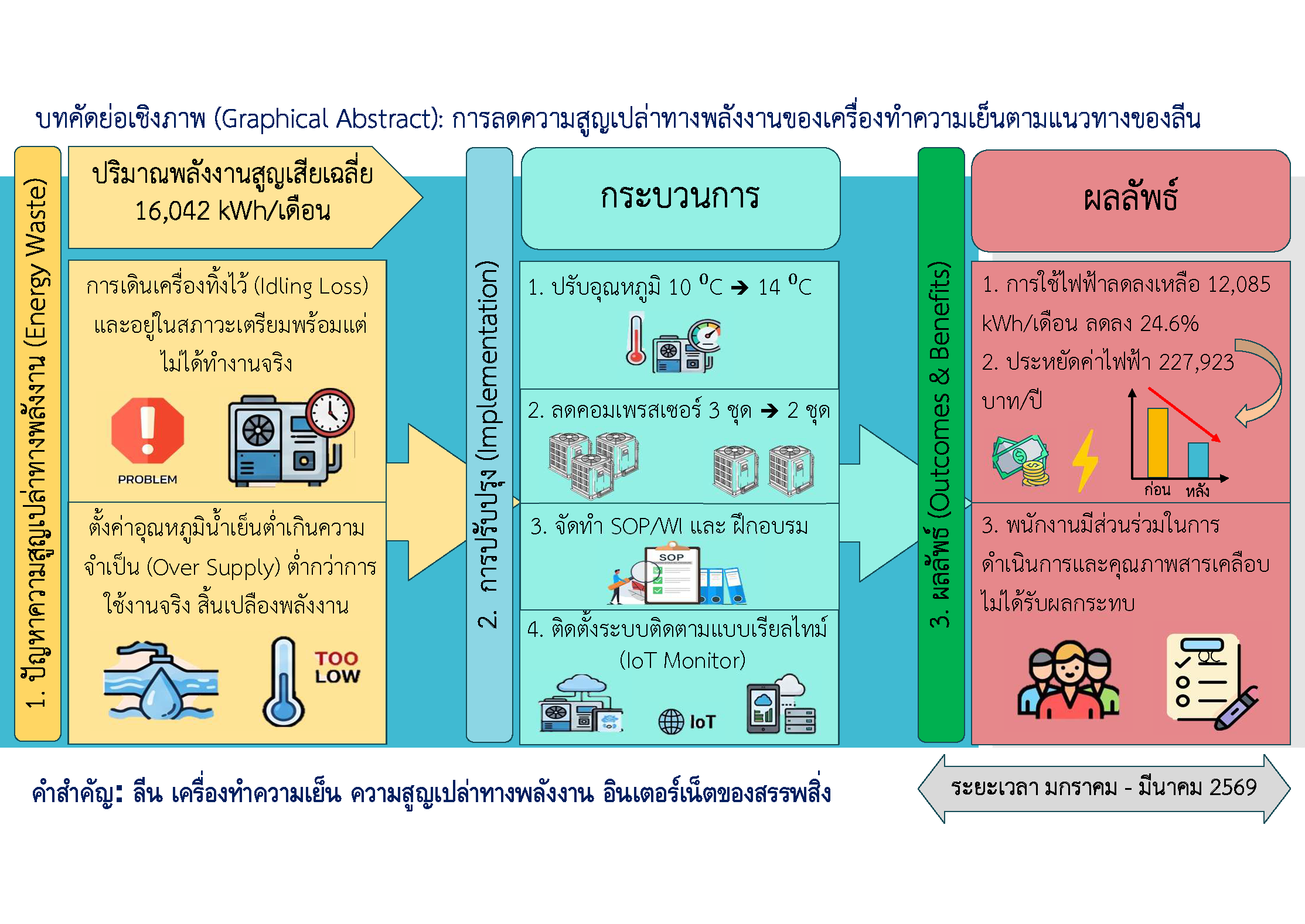
This research aims to analyze the causes of energy waste in a refrigeration system (chiller) used in the metal can coating production process at a packaging manufacturing company. The chiller system was identified as the highest energy–consuming system in the production process, with an average electricity consumption of 16,042 kWh per month. The study identified two primary causes of energy waste: operating the system in standby mode and setting the chilled water temperature below the requirement, resulting in excessive energy consumption (over–supply). Based on these findings, four improvement measures were implemented: (1) increasing the chilled water temperature from 10 °C to 14 °C to better match the actual cooling load, (2) reducing the number of operating compressors from three units to two units, (3) establishing standard operating procedures (SOP), work instructions (WI), and user training programs, and (4) installing an Internet of Things (IoT) system to measure and monitor energy consumption in real time. The implementation results during January–March 2026 showed that the average electricity consumption decreased to 12,085 kWh per month, representing a reduction of 24.6%, without affecting the quality of the coating product. This resulted in an estimated annual energy cost saving of approximately 227,923 THB. In addition, employees became more involved in promoting efficient energy use practices.
References
Intellify Industry Report, “Thailand's Energy Industry Outlook 2025–2030,” Sep. 13, 2025. [Online]. Available: https://www.intellifyglobal.com/thailand–energy–industry–outlook–2025/. [Accessed Sep. 13, 2025]. (in Thai).
A. Rodphai and L. Sriratana, “Reducing Energy Use in Aluminum Furnaces by Applying Lean Energy Concepts: A Case Study of Seng Chun Asia Co., Ltd.,” in Proceedings of the 21st Kasetsart University Kamphaeng Saen National Conference 2024, Nakhon Pathom, Thailand, 2024, pp. 650–661 (in Thai).
S. Pimsakul, Supply Chain Management, Bangkok, Thailand, 2017 (in Thai).
S. Inthongkham, “Reducing the Specific Energy Consumption (SEC) By Increase in Overall Equipment Effectiveness (OEE) Case Study of Electrolytic De flash and Water Jet Machine” M. S. Independent Study, University of Chulalongkorn, Bangkok, 2022 (in Thai).
C. Wongwian, K. Sagulpongmalee, and C. Inyasri, “Propeller Mass Reduction of the Electric Motor in Ring–Spinning Machine in Textile Industry for Energy Saving,” Thai Industrial Engineering Network Journal, vol. 7, no. 2, pp. 111–117, 2021 (in Thai).
W. Klinbun, R. Yadseang, N. Suchisong, and J. Klinbun, “Design of Sandblasting Machine to Reduce Waste in the Production of Motorcycle Exhaust Muffler,” Manufacturing and Management Technology Journal, vol. 3, no. 2, pp. 1–8, 2024 (in Thai).
M. Abdul Aziz and R. Eddy Nugroho, “Reducing Electrical Power Consumption SEEC by 2 kWh/ton Cement and Increaseing Production Rate by 10–15 TPH through Diaphragm Slot Cleaning and Grinding Ball Addition in Chambers 1 and 2,” in The Mercu Buana Ecobiz International Conference: Innovation and Operational Efficiency in Energy Business, Jakarta, Indonesia, 2025, pp. 76–90.
S. Jia, S. Wang, W. Cai, J. Lv, S. Li, Z. S. Li, G. Zhou, and L. Hu, “Energy–Saving Strategy and Method of Spindle Deceleration During No–Load Operation of Machine Tools for Energy Lean Management,” Energy Conversion and Management, vol. 300, pp. 1–13, 2024.
J. Cosgrove, M. J. R. Duarte, J. Littlewood, and P. Wilgeroth, “An Energy Mapping Methodology to Reduce Energy Consumption in Manufacturing Operations,” in Proceedings of the Institution of Mechanical Engineers, Part B: Journal of Engineering Manufacture, vol. 230, pp. 1–9, 2016.
L. Incipini, M. E. Mehtedi, T. Mancia, and P. Pierleoni, “IoT Network for Industrial Machine Energy Monitoring,” in Proceedings of the International Conference on Advances in Education and Information Technology, 2019, pp. 1–6.
Thai National LCI Database, “TIIS–MTEC–NSTDA (with TGO Electricity 2016–2018),” [Online]. Available: https://thaicarbonlabel.tgo.or.th/index.php?lang=TH&mod=YhKdlpIVmpkSE5m
WlcxcGMzTnBiMjQ9. [Accessed Feb. 8, 2026]. (in Thai).
Downloads
Published
How to Cite
Issue
Section
License
Copyright Notice articles, information, images, etc. was published in this Journal of Manufacturing and Management Technology is a copyright of the Journal of Manufacturing and Management Technology. If any person or deparment wants to bring all or part of it for publish or take any action. Authorization is required in written form from the Journal of Manufacturing and Management Technology only.


