
Design and Performance Analysis of an Automatic Mould Forming Machine for Steamed Sticky Rice
Keywords:
Automatic Khao Tom Mud Forming Machine, Pneumatic System, Programmable Logic Controller, Compression Force, Production CapacityAbstract
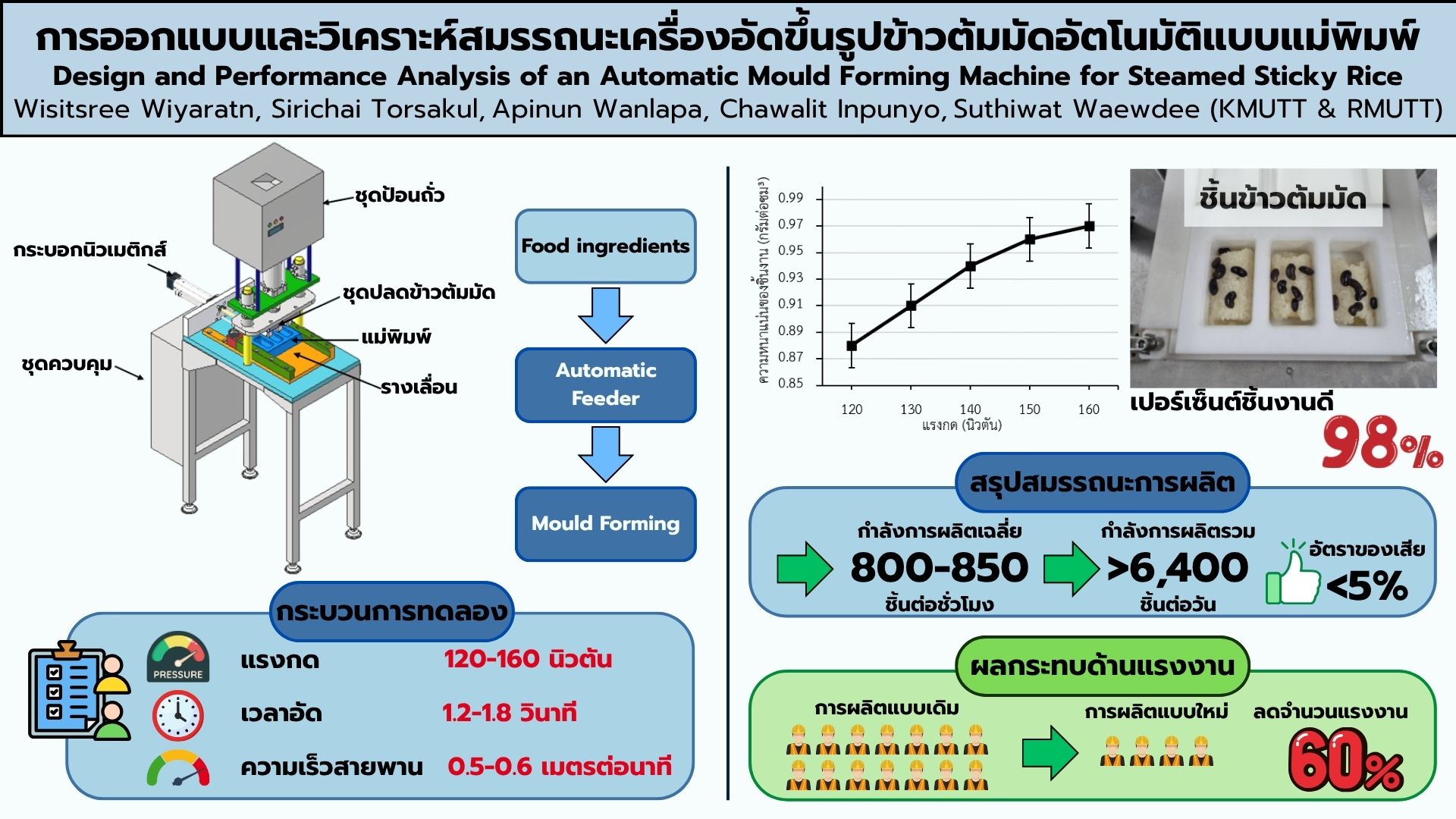
This research aimed to design and analyze the performance of an automatic mold-forming machine for steamed Sticky Rice by integrating a pneumatic system with a Programmable Logic Controller (PLC)-based automation system in order to increase production capacity, reduce labor requirements, and improve product consistency. The prototype machine was designed with a mold-forming mechanism capable of forming three pieces per operating cycle and integrated with automatic black bean feeding and conveyor systems. A Design of Experiment (DOE) approach was employed to investigate the effects of compression force, forming time, and conveyor speed on product quality. The response variables included product density, defect rate, shape uniformity, and production capacity. Experimental results revealed that the optimal compression force ranged between 140–150 N, resulting in the highest percentage of acceptable products at 97–98 percent The developed system achieved an average production capacity of 800–850 pieces per hour, or more than 6,400 pieces per day, with a defect rate lower than 5 percent. Furthermore, the automated production line reduced labor requirements by more than 60percent compared with the conventional manual process. The findings demonstrate that the developed automatic mold-forming machine has strong potential for practical implementation in traditional food industries and can significantly enhance production efficiency and support the transformation toward smart food manufacturing systems.
References
MGR Online, “Getting to Know 'Bai Salat Thai Dessert Leaf', Dominating the Khao Tom Mud Export Market for Over 40 Years,” Manager Online, Jun. 08, 2016. [Online]. Available: https://mgronline.com/smes/detail/9590000057048 (in Thai).
Shweta et al., “Assessment of Advancements and Applications of Robotics, Artificial Intelligence, and Automated Technology in the Modern Food Sector,” Applied Food Research, vol. 5, no. 2, p. 101261, Aug. 2025, doi: 10.1016/j.afres.2025.101261.
L. Zhang, R. M. Boom, and Y. Ma, “Machine Learning in Automated Food Processing: A Mini Review,” Annual Review of Food Science and Technology, vol. 16, no. 1, pp. 25–37, Apr. 2025, doi: 10.1146/annurev-food-111523-122039.
V. S. Rao, P. S. K., and S. K. V., “Design of PLC Based Automated Food Processing Machine,” International Journal of Mechanics, vol. 15, pp. 22–29, Feb. 2021, doi: 10.46300/9104.2021.15.3.
E. Misimi, A. Olofsson, A. Eilertsen, E. R. Øye, and J. R. Mathiassen, “Robotic Handling of Compliant Food Objects by Robust Learning from Demonstration,” arXiv preprint arXiv:2309.12856, Sep. 2023, doi: 10.48550/arxiv.2309.12856.
B. Vogel-Heuser, J. Fischer, S. Feldmann, S. Ulewicz, and S. Rösch, “Modularity and Architecture of PLC-Based Software for Automated Production Systems: An Analysis in Industrial Companies,” Journal of Systems and Software, vol. 131, pp. 35–62, May 2017, doi: 10.1016/j.jss.2017.05.051.
L. Zhu, P. Spachos, E. Pensini, and K. Plataniotis, “Deep Learning and Machine Vision for Food Processing: A Survey,” arXiv preprint arXiv:2103.16106, Mar. 2021, doi: 10.48550/arxiv.2103.16106.
C. I. Cardona, H. A. Tinoco, L. Perdomo-Hurtado, E. Duque-Dussán, and J. Banout, “Optimizing Harvesting Efficiency: Development and Assessment of a Pneumatic Air Jet Excitation Nozzle for Delicate Biostructures in Food Processing,” Foods, vol. 13, no. 10, p. 1458, May 2024, doi: 10.3390/foods13101458.
R. Komljenovic and R. Komljenovic, “Food Manufacturing Companies Rely on Pneumatic Actuators,” JHFOSTER, Apr. 02, 2026. [Online]. Available: https://jhfoster.com/automation-blogs/food-manufacturing-companies-rely-on-pneumatic-actuators/
Y. Kim and S. Kim, “Automation and Optimization of Food Process Using CNN and Six-Axis Robotic Arm,” Foods, vol. 13, no. 23, p. 3826, Nov. 2024, doi: 10.3390/foods13233826.
Downloads
Published
How to Cite
Issue
Section
License
Copyright Notice articles, information, images, etc. was published in this Journal of Manufacturing and Management Technology is a copyright of the Journal of Manufacturing and Management Technology. If any person or deparment wants to bring all or part of it for publish or take any action. Authorization is required in written form from the Journal of Manufacturing and Management Technology only.


