Experimental Investigation of the Heat Transfer Performance of a Two-Phase Closed Thermosyphon under Different Inclination Angles and Filling Ratios Using Dimensionless Analysis
Keywords:
Two-Phase Closed Thermosyphon, Heat Transfer Performance, Filling Ratio, Inclination Angle, Dimensionless ParametersAbstract
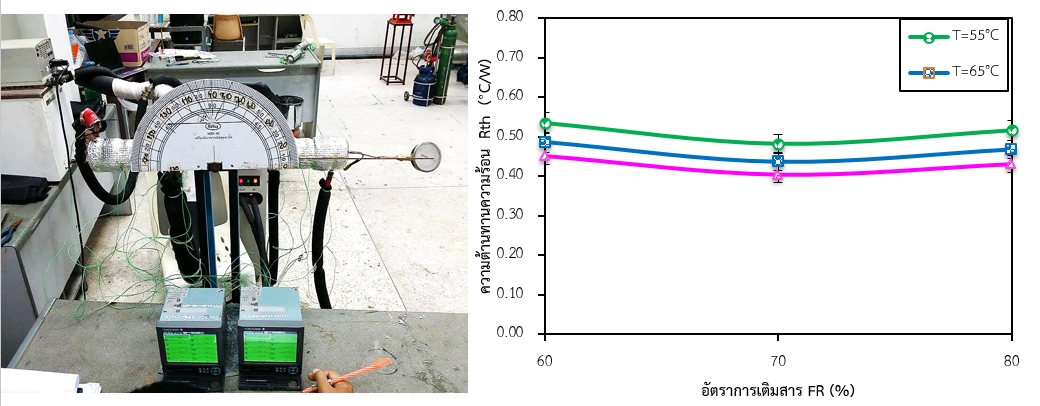
The primary purpose of this paper is to find the interaction between the inclination angle and filling ratio on the performance of a two-phase closed thermosyphon as both two parameters are rarely studied together in detail so far. The tests were conducted at an inclination angle of 15°, 20° and 25° from horizontal plane and filling ratios of 60%, 70% and 80% of the evaporator volume by ethanol. A copper tube with a diameter of 22 mm and a total length of 450 mm was used in the experiment; the tube was divided into three parts; 150 mm heating section, an adiabatic section, and a cooling section. The hot fluid inlet temperatures were 55, 65 and 85 °C and the cooling water was held at 20 °C constant. The results of the two-phase closed thermosyphon performance were evaluated based on the recovered heat transfer rate, thermal resistance, and by a second evaluation from the heat transfer inside the machine. To understand the figures the Nusselt number, Rayleigh number and Jakob number were used as dimensionless parameters. Based on the experimental results, it is found that the two-phase closed thermosyphon with 70% filling ratio and inclined at 20° gives the highest heat transfer performance. The thermal resistance was the lowest under these conditions, and the heat transfer was the highest amongst other conditions tested and the theory of boiling and natural convection was in good agreement. Clearly from this study, both the inclination angle and the filling ratio influence a lot the heat transfer efficiency within the two-phase closed thermosyphon. The data obtained will be useful for further design and implementation of the waste heat recovery systems.
References
Ghahremani, A., Maleknezhad, A., & Shafii, M. B. (2026). Design and performance of a hybrid thermosyphon heat pipe for simultaneous heat transfer and energy harvesting. Results in Engineering, 110748. https://doi.org/10.1016/j.rineng.2026.110748
Malleswararao, K., Bürger, I., Mejia, A. C., Kim, S. T., & Linder, M. (2026). Innovative approaches to waste heat recovery: Coupling high temperature vapour compression heat pumps with salt hydrate thermochemical systems. Applied Energy, 405, 127229. https://doi.org/10.1016/j.apenergy.2025.127229
Forman, C., Muritala, I. K., Pardemann, R., & Meyer, B. (2016). Estimating the global waste heat potential. Renewable and Sustainable Energy Reviews, 57, 1568–1579. https://doi.org/10.1016/j.rser.2015.12.192
Lomonaco, G., Borreani, W., Bruzzone, M., Chersola, D., Firpo, G., Osipenko, M., Saracco, P. (2018). Initial thermal-hydraulic assessment by OpenFOAM and FLUENT of a subcritical irradiation facility. Thermal Science and Engineering Progress, 6, 447–456. https://doi.org/10.1016/j.tsep.2018.03.003
Sichamnan, S., Pipatpaiboon, N., Chaiwongsa, P., Onsalung, N., Intarachaisri, K., Thongdaeng, S., Chaithongsri, A. (2026). Experimental investigation of triangular transversely corrugated tubes for solar air collectors under low solar irradiance. Solar Compass, 100165. https://doi.org/10.1016/j.solcom.2026.100165
Faghri, A. (2014). Heat pipes: Review, opportunities and challenges. Frontiers in Heat Pipes, 5(1). https://doi.org/10.5098/fhp.5.1
Kang, S., Lee, S., & Lee, J. (2025). Performance enhancement of two-phase closed thermosyphon with threaded evaporator surface. International Communications in Heat and Mass Transfer, 164, 108939. https://doi.org/10.1016/j.icheatmasstransfer.2025.108939
Sae-Jung, P., Krittayanawach, T., Deedom, P., & Limmeechokchai, B. (2015). An experimental study of thermo-syphon solar water heater in Thailand. Energy Procedia, 79, 442–447. https://doi.org/10.1016/j.egypro.2015.11.516
Rittidech, S., Donmaung, A., & Kumsombut, K. (2009). Experimental study of the performance of a circular tube solar collector with closed-loop oscillating heat-pipe with check valve (CLOHP/CV). Renewable Energy, 34(10), 2234–2238. https://doi.org/10.1016/j.renene.2009.03.021
Jengsooksawat, S., Rittidech, S., & Booddachan, K. (2014). Loop thermosyphon with vapour chamber: A thermodynamic study. Advances in Mechanical Engineering, 6, 487191. https://doi.org/10.1155/2014/487191
Mutalikdesai, S., & Kate, A. (2020). Experimental investigation of an aluminium thermosyphon at normal operating conditions. Journal of Thermal Engineering, 6(5), 724–735. https://doi.org/10.18186/thermal.797291
Shabgard, H., Xiao, B., Faghri, A., Gupta, R., & Weissman, W. (2014). Thermal characteristics of a closed thermosyphon under various filling conditions. International Journal of Heat and Mass Transfer, 70, 91–102. https://doi.org/10.1016/j.ijheatmasstransfer.2013.10.053
Lin, C.-W., Hsu, H.-Y., & Kumar, R. (2024). Numerical investigation of surface wettability effect on two-phase closed thermosyphon. Applied Thermal Engineering, 247, 123125. https://doi.org/10.1016/j.applthermaleng.2024.123125
Ghaffari, O., Al Sayed, C., Vincent, M., Grenier, F., Jasmin, S., Fréchette, L., & Sylvestre, J. (2022). Study of the impact of the airflow and filling ratio on the thermal performances of a two-phase immersion cooling prototype. In 2022 21st IEEE Intersociety Conference on Thermal and Thermomechanical Phenomena in Electronic Systems (iTherm). https://doi.org/10.1109/iTherm54085.2022.9899558
Lataoui, Z., Benselama, A. M., & Jemni, A. (2025). Heat transfer characteristics of thermosyphons used in vacuum water heaters. Fluids, 10(8), 199. https://doi.org/10.3390/fluids10080199
Khaongam, K., & Srihajong, N. (2015). Heat transfer characteristics of thermo-syphon: Case study of modifying inclination angle of evaporator and condenser sections. Food Agricultural Sciences and Technology, 1(2), 57–62. https://doi.org/10.14456/randk.2015.9
Solomon, A. B., Daniel, V. A., Ramachandran, K., Pillai, B., Singh, R. R., Sharifpur, M., & Meyer, J. (2017). Performance enhancement of a two-phase closed thermosiphon with a thin porous copper coating. International Communications in Heat and Mass Transfer, 82, 9–19. https://doi.org/10.1016/j.icheatmasstransfer.2017.02.001
Gedik, E. (2016). Experimental investigation of the thermal performance of a two-phase closed thermosyphon at different operating conditions. Energy and Buildings, 127, 1096–1107. https://doi.org/10.1016/j.enbuild.2016.06.066
Zhang, H., Zhang, Z., Yang, L., & Li, Y. (2025). Numerical investigation on thermal efficiency and resistance of high-temperature thermosiphons using dimensionless method. Case Studies in Thermal Engineering, 73, 106391. https://doi.org/10.1016/j.csite.2025.106391
Chami, N., & Zoughaib, A. (2010). Modeling natural convection in a pitched thermosyphon system in building roofs and experimental validation using particle image velocimetry. Energy and Buildings, 42(8), 1267–1274. https://doi.org/10.1016/j.en build.2010.02.019
Xu, H., Guo, X., Yang, S., Tang, F., Zhang, B., & Wang, K. (2025). Influence of height difference on thermal performance and flow stability of loop thermosyphon equipped with vertically placed flat evaporator for IGBT module cooling. International Journal of Thermal Sciences, 218, 110124. https://doi.org/10.1016/j.ijthermalsci.2025.110124
Cai, Y., Liu, Z., Lu, J., Li, Y., Tang, D., & Hu, C. (2026). Establishment of momentum model and analysis of heat transfer performance for two-phase loop thermosyphon. International Journal of Heat and Mass Transfer, 259, 128344. https://doi.org/10.1016/j.ijheatmasstransfer.2026.128344
Perinba Selvin Raj, J. A., Asirvatham, L. G., Angeline, A. A., Rakshith, B. L., Bose, J. R., Manova, S., Wongwises, S. (2025). Mitigation of flow instabilities in multiport minichannel thermosyphon through a modified loop design with separate vapor-liquid paths. Case Studies in Thermal Engineering, 73, 106495. https://doi.org/10.1016/j.csite.2025.106495
Mana, V. V., Asirvatham, L. G., Manova, S., Appadurai, A. A., Kumar, J. P., Leunanonchai, W., & Wongwises, S. (2025). Experimental investigation on the heat transfer performance of a loop thermosyphon with dual vapor lines. Case Studies in Thermal Engineering, 70, 106074. https://doi.org/10.1016/j.csite.2025.106074
He, Y., Hao, T., Makhatha, M. E., Feng, Y., & Qiu, L. (2026). Heat transfer and instability characteristics of a two-phase thermosyphon loop with wide range of filling ratios. International Communications in Heat and Mass Transfer, 174, 110938. https://doi.org/10.1016/j.icheatmasstransfer.2026.110938
Smith, K., Siedel, S., Robinson, A. J., & Kempers, R. (2016). The effects of bend angle and fill ratio on the performance of a naturally aspirated thermosyphon. Applied Thermal Engineering, 101, 455–467. https://doi.org/10.1016/j.applthermaleng.2016.01.024
Rukruang, A., Kaew-On, J., Wongwises, S., & Wang, C.-C. (2025). Experimental optimization and performance limits of a multiport minichannel thermosyphon for air-cooled applications. Applied Thermal Engineering, 127540. https://doi.org/10.1016/j.appl thermaleng.2025.127540
Larimi, Y. N., Ghaffari, O., Ganjali, A., Al Sayed, C., Grenier, F., Jasmin, S., … Sylvestre, J. (2022). Multi-scale electroplated porous coating for immersion cooling of electronics. In 2022 21st IEEE Intersociety Conference on Thermal and Thermomechanical Phenomena in Electronic Systems (iTherm). https://doi.org/10.1109/itherm54085.2022.9899660
Vincent, M., Ghaffari, O., Larimi, Y. N., Grenier, F., Jasmin, S., Fréchette, L., & Sylvestre, J. (2024). Experimental investigation of the thermal resistance of advanced two-phase thermosyphon heatsinks. Journal of Cleaner Production, 238, 122108. https://doi.org/10.1016/j.jclepro.2017.11.157
Ghaffari, O., Vincent, M., Grenier, F., Larimi, Y., Jasmin, S., Fréchette, L., & Sylvestre, J. (2023). Pushing the limits of air cooling with novel two-phase prototypes for high power microprocessors. In 2023 22nd IEEE Intersociety Conference on Thermal and Thermomechanical Phenomena in Electronic Systems (ITherm). https://doi.org/10.1109/ itherm55368.2023.10177612
Wansasueb, K., Promthaisong, P., Bubphachot, B., Pattiya, A., Chompookham, T., Rittidech, S., & Siriwan, N. (2024). Applied machine learning: Performance prediction of heat pipe with mesh wick. Case Studies in Thermal Engineering, 63, 105307. https://doi.org/10.1016/j.csite.2024.105307
Wang, Y., Ma, K., Liu, Y., Sun, J., & Huang, L. (2026). Experimental and empirical correlation study on the heat transfer characteristics of gravity heat pipes. International Communications in Heat and Mass Transfer, 170, 110028. https://doi.org/10.1016/j.icheatmasstransfer.2025.110028
Khaongam, K., Chompookham, T., & Parametthanuwat, T. (2025). Internal flow pattern of the condenser section that affects the heat transfer characteristics of rectangular two-phase closed thermosyphon. Case Studies in Thermal Engineering, 72, 106246. https://doi.org/10.1016/j.csite.2025.106246
Pipatpaiboon, N., Thongdang, S., & Rittidech, S. (2016). Reducing heat loss in the adiabatic section of a two-phase closed thermosyphon (TPCT) using acrylic tube. King Mongkut’s University of Technology North Bangkok International Journal of Applied Science and Technology, 9(3). https://doi.org/10.14416/j.ijast.2016.06.001
Wang, Y., Wang, X., Wang, J., Liu, Y., & Chen, J. (2023). Heat transfer performance of a two-phase closed thermosyphon with different inclination angles based on the core-tube monitoring. Case Studies in Thermal Engineering, 42, 102738. https://doi.org/10.1016/j.csite.2023.102738
Tian, J. A., Xu, Z., Chen, K., Gan, H., Liu, C., Zhao, J., & Rao, Z. (2026). Classic yet vibrant heat transfer device—gravity heat pipe: A review from working mechanism to application. Renewable and Sustainable Energy Reviews, 238, 117073. https://doi.org/10.1016/j.rser.2026.117073
Ma, Y., Lin, Y., Qi, G., Li, X., & Jiang, F. (2026). Effect of inclination angle and particle size on the thermal performance of a three-phase closed thermosyphon. International Communications in Heat and Mass Transfer, 172, 110269. https://doi.org/10.1016/j.icheatmasstransfer.2025.110269
Jiang, F., Lin, Y., Liu, Y., Qi, G., Li, H., Li, X., … Li, X. (2022). Effect of inclination angle on the thermal performance of a three-phase closed thermosyphon containing SiC particles. International Journal of Heat and Mass Transfer, 197, 123361. https://doi.org/10.1016/j.ijheatmasstransfer.2022.123361
Yilgor, I., & Shi, S. (2025). Operational characteristics and oscillatory phenomena in two-phase closed thermosyphons. Applied Thermal Engineering, 265, 125401. https://doi.org/10.1016/j.applthermaleng.2024.125401
Tan, Z., Zhang, Z., Chu, W., & Wang, Q. (2026). Investigation on heat and mass transfer mechanism within a thermosyphon fin under multiple power distributions. Applied Thermal Engineering, 130715. https://doi.org/10.1016/j.applthermaleng.2026.130715
Thongdang, S., Ding, Y., Parametthanuwat, T., Mondragón, R., & Sichamnan, S. (2026). Thermal and exergy efficiency analysis of a corrugated thermosyphon water heater integrated with an evacuated tube solar collector using TiO₂ nanofluid. Next Energy, 12, 100691. https://doi.org/10.1016/j.nxener.2026.100691
Xu, H., Guo, X., Liu, Z., Yang, S., Zhang, B., & Tian, S. (2026). Hydrodynamic coupling in vertical flat-plate loop thermosyphons: The critical role of riser confinement on operational stability and heat transfer limits. International Journal of Heat and Mass Transfer, 263, 128711. https://doi.org/10.1016/j.ijheatmasstransfer.2026.128711
Lu, X., Liu, J., Tong, X., Dai, R., Xiao, Y., & Deng, J. (2025). Experimental investigation on thermal performance of gravity heat pipe with different pipe configurations. Case Studies in Thermal Engineering, 65, 105695. https://doi.org/10.1016/j.csite.2024.105695
Gou, X., Li, G., Zhang, R., Jian, C., Zhang, Q., Li, B., & Dong, Q. (2021). Critical and optimal inclination angles of two-phase closed thermosyphon under different operating conditions. International Journal of Heat and Mass Transfer, 177, 121540. https://doi.org/10.1016/j.ijheatmasstransfer.2021.121540
Siriwan, N., Chompookham, T., Ding, Y., & Rittidech, S. (2017). Heat transfer predictions for helical oscillating heat pipe heat exchanger: Transient condition. Journal of Mechanical Science and Technology, 31(7), 3553–3562. https://doi.org/10.1007/s12206-017-0642-y
Paramatthanuwat, T., Boothaisong, S., Rittidech, S., & Booddachan, K. (2010). Heat transfer characteristics of a two-phase closed thermosyphon using deionized water mixed with silver nano. Heat and Mass Transfer, 46(3), 281–285. https://doi.org/10.1007/s00231-009-0565-y
Zhang, T., Yan, Z., Wang, L., Zheng, W., Su, Y., & Zheng, R. (2021). Droplet entrainment within the evaporator to the suitable volume-filling ratio of a vertical two-phase closed thermosyphon. International Journal of Thermal Sciences, 159, 106576. https://doi.org/10.1016/j.ijthermalsci.2020.106576
Zhang, W., Cheng, K., Lu, J., Chen, H., & Zhang, Y. (2026). The influence of cooling temperature on the thermal-dynamic performance of wettability-driven pulsating heat pipes. International Communications in Heat and Mass Transfer, 172, 110701. https://doi.org/10.1016/j.icheatmasstransfer.2026.110701
Robinson, A. J., Smith, K., Hughes, T., & Filippeschi, S. (2020). Heat and mass transfer for a small diameter thermosyphon with low fill ratio. International Journal of Thermofluids, 1, 100010. https://doi.org/10.1016/j.ijft.2019.100010
Khaongam, K., Srihajong, N., Seahang, K., & Pratoomchat, P. (2014). Thermal performance of closed-loop oscillating heat pipes with check valves using AgNO₃/distilled water nanofluids. In The 6th International Conference on Science, Technology and Innovation for Sustainable Well-Being (STISWB VI 2014). https://doi.org/10.13140/RG.2.2.33101.74728
Kim, I. G., Kim, K. M., Jeong, Y. S., & Bang, I. C. (2017). Flow visualization and heat transfer performance of annular thermosyphon heat pipe. Applied Thermal Engineering, 125, 1456–1468. https://doi.org/10.1016/j.applthermaleng.2017.07.116
Schreiber, M., Wits, W. W., & te Riele, G. J. (2016). Numerical and experimental investigation of a counter-current two-phase thermosyphon with cascading pools. Applied Thermal Engineering, 99, 133–146. https://doi.org/10.1016/j.applthermaleng.2015.12.095
Geetha, A., Rabhi, A., Van Wyk, S., Andersson, M., & Akkus, Y. (2026). Numerical stability assessment of 2D and 3D VOF-based modeling of pulsating heat pipe loops: Influence of physical assumptions and numerical parameters. Applied Thermal Engineering, 131097. https://doi.org/10.1016/j.applthermaleng.2026.131097
Yang, S., Guo, X., Xu, H., Tang, F., Zhang, B., & Zhang, Y. (2025). Experimental studies on the heat transfer characteristics and instability of a loop thermosyphon with a vertical flat evaporator for IGBT heat dissipation. Applied Thermal Engineering, 264, 125524. https://doi.org/10.1016/j.applthermaleng.2025.125524
Shelton, M. J., Suresh, S., & Singh, V. K. (2025). Experimental analysis and optimization of two-phase flexible water thermosyphons with corrugated adiabatic sections. Applied Thermal Engineering, 128659. https://doi.org/10.1016/j.applthermaleng.2025.128659
Noie, S. (2005). Heat transfer characteristics of a two-phase closed thermosyphon. Applied Thermal Engineering, 25(4), 495–506. https://doi.org/10.1016/j.applthermaleng.2004.06.019
Rahma, A. G., Abadassi, F., Ghenaim, A., François, P., Hoarau, Y., Funfschilling, D., & Marouf, A. (2026). Thermal and flow pattern analysis under confinement and vapor superficial velocity conditions in a two-phase closed thermosiphon: A numerical study. International Journal of Heat and Mass Transfer, 265, 128849. https://doi.org/10.1016/j.ijheatmasstransfer.2026.128849
Aragones, D. I., Warsinger, D. M., & Weibel, J. (2026). Mapping the saturated regime operating envelope of a two-phase closed loop thermosyphon for minimum thermal resistance. International Journal of Heat and Mass Transfer, 261, 128509. https://doi.org/10.1016/j.ijheatmasstransfer.2026.128509
Kim, G., & Lee, J. (2026). Balancing bubble dynamics and liquid replenishment in a two-phase closed thermosyphon via geometrically tuned bi-philic evaporator surfaces. Applied Thermal Engineering. https://doi.org/10.1016/j.applthermaleng.2026.130727
Ma, Y., Lin, Y., Qi, G., Li, X., & Jiang, F. (2026). Effect of inclination angle and particle size on the thermal performance of a three-phase closed thermosyphon. International Communications in Heat and Mass Transfer, 172, 110269. https://doi.org/10.1016/j.icheatmasstransfer.2025.110269
Balaguru, N. K., Suresh, S., Shelton, M. J., Krishnan, S. A., & Singh, V. K. (2026). Thermal characterization of bendable water filled two-phase thermosyphons under variable fill ratios and bending angles. Applied Thermal Engineering, 131228. https://doi.org/10.1016/j.applthermaleng.2026.131228
Zhu, L., Zhao, Y., & Wu, F. (2026). A key condition quotient method for heat conduction conditional uncertainty propagation. International Communications in Heat and Mass Transfer, 171, 110207. https://doi.org/10.1016/j.icheatmasstransfer.2025.110207