
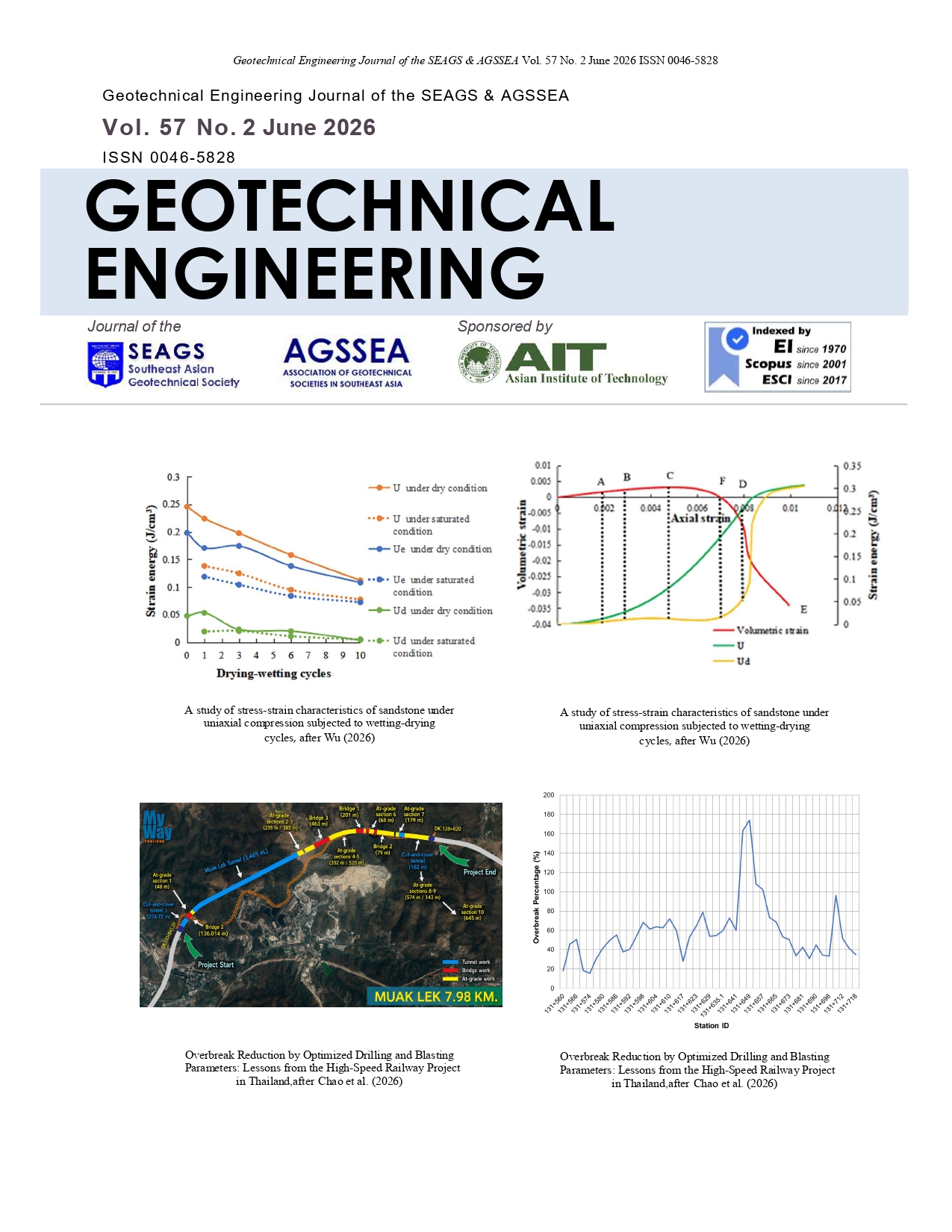
A Study of Stress-Strain Characteristics of Sandstone under Uniaxial Compression Subjected to Wetting-Drying Cycles
Article Sidebar
Main Article Content
Abstract
To study the mechanical characteristics of sandstone subjected to wetting-drying cycles, the paper studies the failure characteristic stress of sandstone subjected to wetting-drying cycles based on a uniaxial compression test, i.e crack intiation stress , dilatancy stress
, and peak strength
. There is no significant linear correlation between the crack initiation stress and the number of wetting-drying cycles. Based on the law of conservation of energy, the energy characteristics and damage mechanisms of sandstone during failure. The result shows that the total strain energy U, releasable elastic strain energy Ue, and dissipated strain energy Ud absorbed per unit volume of rock are decreasing linearly with the increase in number of wetting-drying cycles. Research finds that shifting from positive volumetric strain to negative volumetric strain (i.e. transforming from compression to dilation) would lead to release of elastic strain energy Ue and drastic rise of dissipated strain energy Ud, and is the turning point from crack propagation to approximate failure. The wetting-drying cycles accelerate the failure of sandstone specimens and reduce the dissipated strain energy Ud required for failure, presenting as a decrease in peak strength and elasticity modulus at the macroscopic level.
Article Details

This work is licensed under a Creative Commons Attribution-NonCommercial-NoDerivatives 4.0 International License.
Copyright © 2019 Association of Geotechnical Societies in Southeast Asia (AGSSEA) - Southeast Asian Geotechnical Society (SEAGS).
