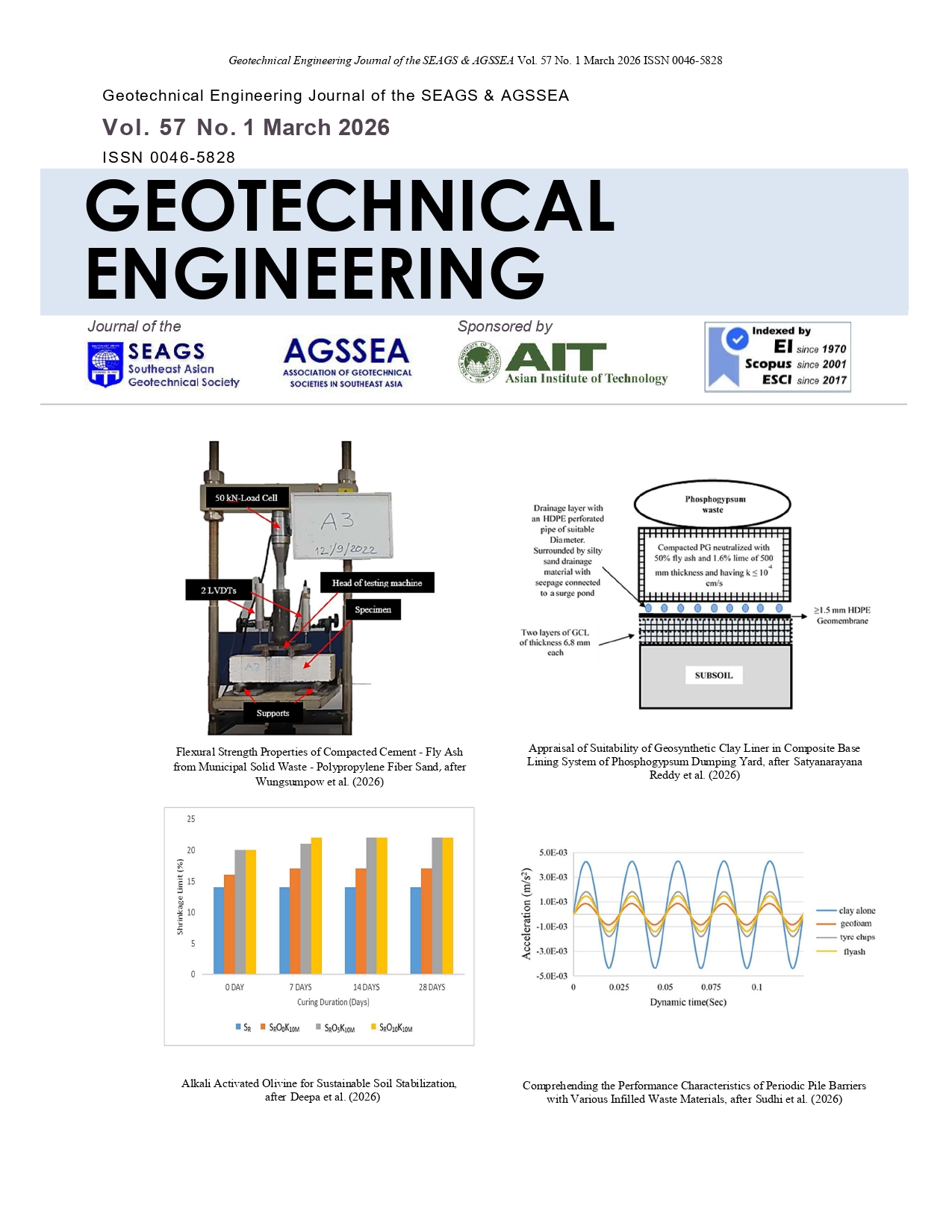
Comprehending the Performance Characteristics of Periodic Pile Barriers with Various Infilled Waste Materials
Article Sidebar
Main Article Content
Abstract
Recent developments in industrial sectors have upgraded machines to enhance production and efficiency. This ultimately leads to heavy vibrations, which are quite detrimental to nearby structures. Therefore, it is essential to mitigate these generated waves using different passive techniques, such as periodic pile barriers. Moreover, in India, the output of waste materials produced every year is double as compared to the production. Hence, utilizing these waste materials into constructional activities will not only protect environmental and ecological damages but also conserve dwindling resources. Thus, this paper aims to utilize the industrial waste materials like fly ash, tyre chips and geofoam as infilled materials for periodic pile barriers, with an intention to isolate these vibrations due to rotating machines. The analysis has been performed using PLAXIS 3D to comprehend the screening efficiency of infilled pile barriers in both sand and clay. A model has been created, and an analysis has been performed to determine the optimal number of piles required for effective isolation. Ten piles with a center-to-center distance of 1 m, a diameter of 0.6 m, and a depth of 9 m have been modelled and kept at a distance of 10 m from the source for validation. Further, analysis has been extended to obtain amplitude reduction curves and time versus acceleration response of each material-infilled pile barrier in clay and sand. The study showcased that geofoam-filled piles have more screening efficiency in clay as compared to the other two materials. However, in sand, the efficacy of the infilled materials is not fulfilled, leading to mediocre performance. This appreciable performance of infilled materials in clay can be due to their better damping effect and impedance ratios.
Article Details

This work is licensed under a Creative Commons Attribution-NonCommercial-NoDerivatives 4.0 International License.
Copyright © 2019 Association of Geotechnical Societies in Southeast Asia (AGSSEA) - Southeast Asian Geotechnical Society (SEAGS).
