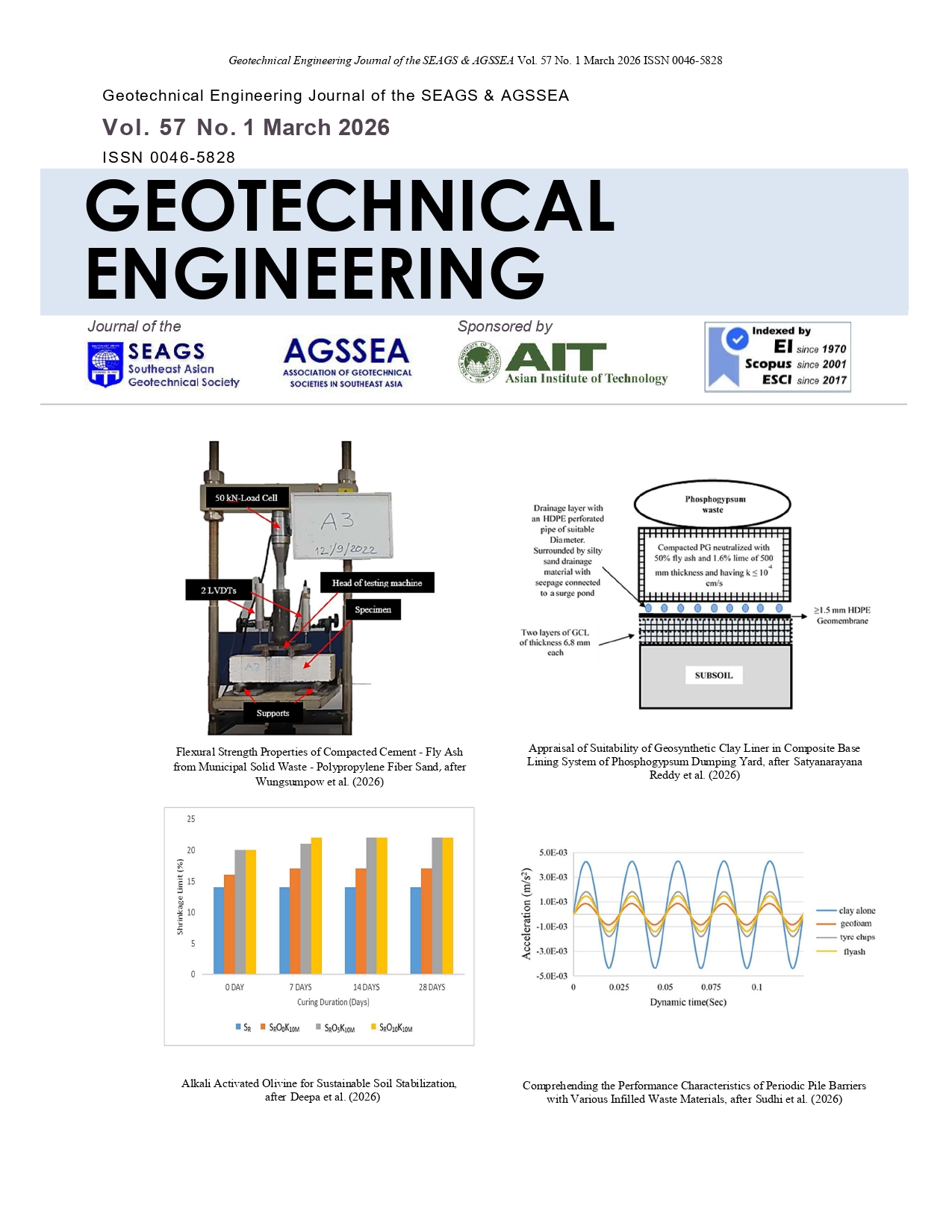
Alkali Activated Olivine for Sustainable Soil Stabilization
Article Sidebar
Main Article Content
Abstract
Alkali-activated material-based binders are increasingly recognized as sustainable alternatives to conventional calcium-based binders for soil stabilization due to their superior mechanical performance and reduced carbon footprint. Magnesium-rich olivine is widely used for carbon dioxide sequestration owing to the natural weathering reaction of olivine with atmospheric carbon dioxide. Magnesium-rich olivine has a weak nesosilicate structure with high SiO2 and MgO content, making it a potential source material for alkali activation. Additionally, stabilizing soil using magnesium-rich olivine in the presence of a strong alkali requires no energy-intensive pretreatments, unlike cement and lime treatment. On comparing with the processes involved in cement and lime manufacturing, the production of dunite rock powder rich in magnesium-rich olivine involves far less carbon dioxide emissions and energy consumption. This Study highlights the efficacy of magnesium-rich olivine as a sustainable source material for alkali activation. Experimental studies were conducted to explore the interactions between kaolinite-rich red earth and alkali-activated olivine, analysing variations in their physicochemical properties and unconfined compressive strength (UCS). A notable reduction in plasticity index, an increase in shrinkage limit, and a reduction in specific surface area values of untreated soil were noted on treatment with alkali-activated olivine. A considerable improvement in UCS value of about 14.9 times over the UCS value of untreated soil was observed when the 5% olivine-treated sample in the presence of 10 M KOH was cured for 28 days. Experimental findings suggest that introducing alkali-activated magnesium-rich olivine to soil induces olivine dissolution, cation exchange, aggregation, and hydration reactions. Microstructural investigations show the formation of Brucite, Hematite, Mullite, and Magnesium silicate hydrate gels in the treated soil, thereby enhancing soil performance.
Article Details

This work is licensed under a Creative Commons Attribution-NonCommercial-NoDerivatives 4.0 International License.
Copyright © 2019 Association of Geotechnical Societies in Southeast Asia (AGSSEA) - Southeast Asian Geotechnical Society (SEAGS).
