
การพัฒนาแบบจำลองการถดถอยเชิงเส้นพหุเพื่อทำนายผลกระทบของการเล่นเกมออนไลน์ต่อพฤติกรรมการเรียนของนักศึกษา
Article Sidebar
Main Article Content
บทคัดย่อ
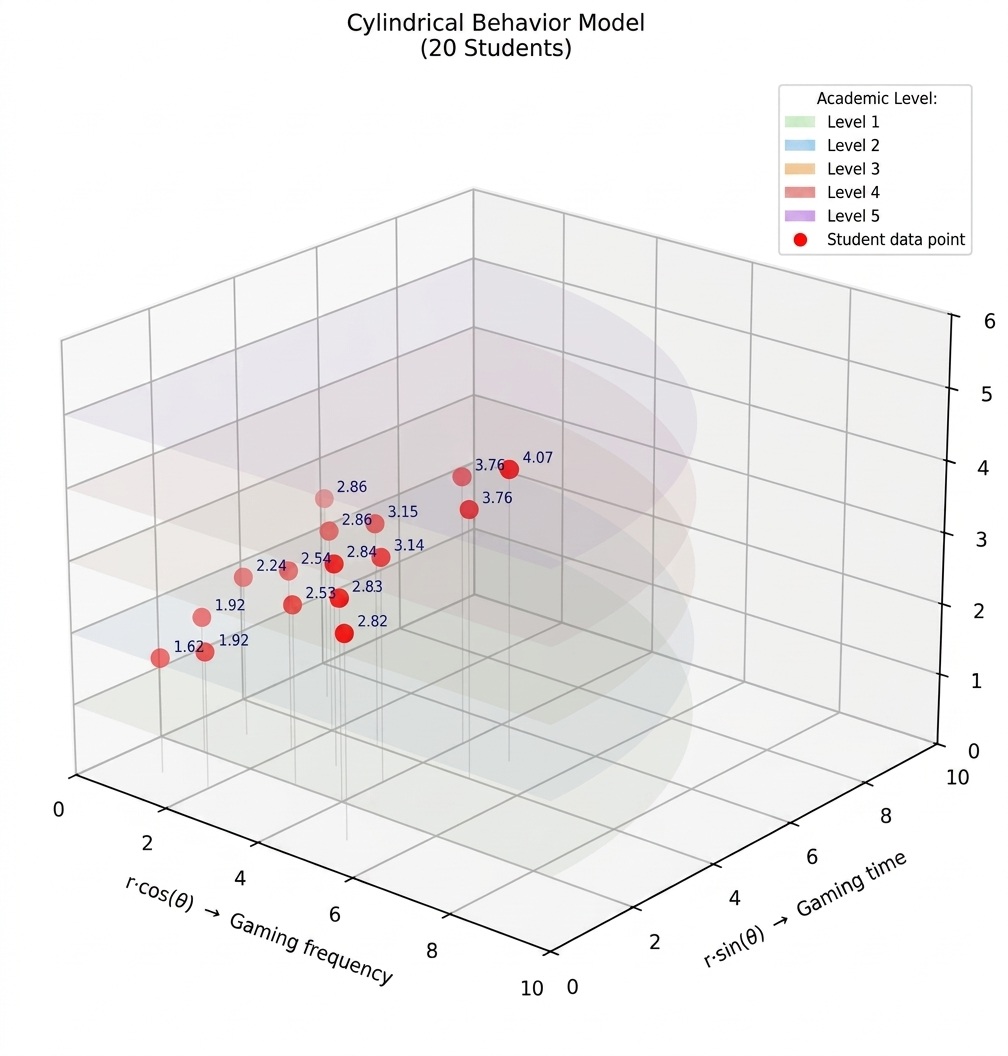
การวิจัยครั้งนี้มีวัตถุประสงค์เพื่อพัฒนาแบบจำลองการถดถอยเชิงเส้นพหุสำหรับทำนายผลกระทบของการเล่นเกมออนไลน์ต่อพฤติกรรมการเรียนของนักศึกษา กลุ่มตัวอย่างเป็นนักศึกษาคณะวิทยาศาสตร์ มหาวิทยาลัยอุบลราชธานี จำนวน 400 คน แบ่งเป็นกลุ่มสร้างแบบจำลอง 380 คน และกลุ่มทดสอบ 20 คน เก็บข้อมูลด้วยแบบสอบถามมาตราส่วนลิเคิร์ต 5 ระดับ ซึ่งผ่านการตรวจสอบคุณภาพด้วยค่า IOC เฉลี่ย 0.90 และค่า Cronbach's alpha เท่ากับ 0.91 ตัวแปรอิสระประกอบด้วย X1 แทนระดับความถี่ในการเล่นเกมต่อวัน และ X2 แทนระดับเวลาในการเล่นเกมต่อวัน ส่วนตัวแปรตามคือ Y แทนระดับผลกระทบต่อพฤติกรรมการเรียน ผลการวิเคราะห์ได้สมการ Ŷ = 1.000 + 0.303(X1) + 0.311(X2) โดยตัวแบบมีค่า R² = 0.579 อธิบายความแปรปรวนของ Y ได้ร้อยละ 57.91 อย่างมีนัยสำคัญทางสถิติที่ระดับ 0.001 นอกจากนี้ยังได้พัฒนาแบบจำลองทรงกระบอกพฤติกรรม (Cylindrical Behavior Model) ที่แปลงผลลัพธ์สู่ระบบพิกัดทรงกระบอก (r, θ, z) เพื่อวิเคราะห์โปรไฟล์พฤติกรรมนักศึกษาใน 3 มิติพร้อมกัน และพัฒนาเป็นโปรแกรมต้นแบบสำหรับใช้งานจริงในบริบทการให้คำปรึกษา
Article Details

อนุญาตภายใต้เงื่อนไข Creative Commons Attribution-NonCommercial-NoDerivatives 4.0 International License.
วารสารวิทยาศาสตร์และวิทยาศาสตร์ศึกษา (JSSE) เป็นผู้ถือลิสิทธิ์บทความทุกบทความที่เผยแพร่ใน JSSE นี้ ทั้งนี้ ผู้เขียนจะต้องส่งแบบโอนลิขสิทธิ์บทความฉบับที่มีรายมือชื่อของผู้เขียนหลักหรือผู้ที่ได้รับมอบอำนาจแทนผู้เขียนทุกนให้กับ JSSE ก่อนที่บทความจะมีการเผยแพร่ผ่านเว็บไซต์ของวารสาร
แบบโอนลิขสิทธิ์บทความ (Copyright Transfer Form)
ทางวารสาร JSSE ได้กำหนดให้มีการกรอกแบบโอนลิขสิทธิ์บทความให้ครบถ้วนและส่งมายังกองบรรณาธิการในข้อมูลเสริม (supplementary data) พร้อมกับนิพนธ์ต้นฉบับ (manuscript) ที่ส่งมาขอรับการตีพิมพ์ ทั้งนี้ ผู้เขียนหลัก (corresponding authors) หรือผู้รับมอบอำนาจ (ในฐานะตัวแทนของผู้เขียนทุกคน) สามารถดำเนินการโอนลิขสิทธิ์บทความแทนผู้เขียนทั้งหมดได้ ซึ่งสามารถอัพโหลดไฟล์บทความต้นฉบับ (Manuscript) และไฟล์แบบโอนลิขสิทธิ์บทความ (Copyright Transfer Form) ในเมนู “Upload Submission” ดังนี้
1. อัพโหลดไฟล์บทความต้นฉบับ (Manuscript) ในเมนูย่อย Article Component > Article Text
2. อัพโหลดไฟล์แบบโอนลิขสิทธิ์บทความ (Copyright Transfer Form) ในเมนูย่อย Article Component > Other
ดาวน์โหลด ไฟล์แบบโอนลิขสิทธิ์บทความ (Copyright Transfer Form)
เอกสารอ้างอิง
Adachi, P. J. C. and Willoughby, T. (2013). More than just fun and games: The longitudinal relationships between strategic video games, self-reported problem solving skills, and academic grades. Journal of Youth and Adolescence, 42(7), 1041–1052.
Anand, V. (2007). A study of time management: The correlation between video game usage and academic performance markers. CyberPsychology, Behavior, and Social Networking, 10(4), 552–559.
Choo, H., Gentile, D. A., Sim, T., Li, D., Khoo, A. and Liau, A. K. (2010). Pathological video-gaming among Singaporean youth. Annals of the Academy of Medicine, Singapore, 39(11), 822–829.
Ferguson, C. J. (2011). Video games and youth violence: A prospective analysis in adolescents. Journal of Youth and Adolescence, 40(4), 377–391.
Fredricks, J. A., Blumenfeld, P. C. and Paris, A. H. (2004). School engagement: Potential of the concept, state of the evidence. Review of Educational Research, 74(1), 59–109.
Gentile, D. A., Choo, H., Liau, A., Sim, T., Li, D., Fung, D. and Khoo, A. (2011). Pathological video game use among youths: A two-year longitudinal study. Pediatrics, 127(2), e319–e329.
Jackson, L. A., Von Eye, A., Witt, E. A., Zhao, Y. and Fitzgerald, H. E. (2011). A longitudinal study of the effects of Internet use and videogame playing on academic performance and the roles of gender, race and income in these relationships. Computers in Human Behavior, 27(1), 228–239.
King, D. L., Haagsma, M. C., Delfabbro, P. H., Gradisar, M. and Griffiths, M. D. (2013). Toward a consensus definition of pathological video-gaming: A systematic review of psychometric assessment tools. Clinical Psychology Review, 33(3), 331–342.
Király, O., Griffiths, M. D. and Demetrovics, Z. (2015). Internet gaming disorder and the DSM-5: Conceptualization, debates, and controversies. Current Addiction Reports, 2(3), 254–262.
Kuss, D. J. and Griffiths, M. D. (2012). Internet gaming addiction: A systematic review of empirical research. International Journal of Mental Health and Addiction, 10(2), 278–296.
Lemmens, J. S., Valkenburg, P. M. and Peter, J. (2011). Psychosocial causes and consequences of pathological gaming. Computers in Human Behavior, 27(1), 144–152.
Pontes, H. M. and Griffiths, M. D. (2015). Measuring DSM-5 internet gaming disorder: Development and validation of a short psychometric scale. Computers in Human Behavior, 45, 137–143.
Przybylski, A. K., Weinstein, N. and Murayama, K. (2017). Internet gaming disorder: Investigating the clinical relevance of a new phenomenon. American Journal of Psychiatry, 174(3), 230–236.
Rosen, L. D., Carrier, L. M. and Cheever, N. A. (2013). Facebook and texting made me do it: Media-induced task-switching while studying. Computers in Human Behavior, 29(3), 948–958.
Tabachnick, B. G. and Fidell, L. S. (2013). Using Multivariate Statistics (6th ed.). Boston: Pearson.
Zimmerman, B. J. (2002). Becoming a self-regulated learner: An overview. Theory Into Practice, 41(2), 64–70.
