
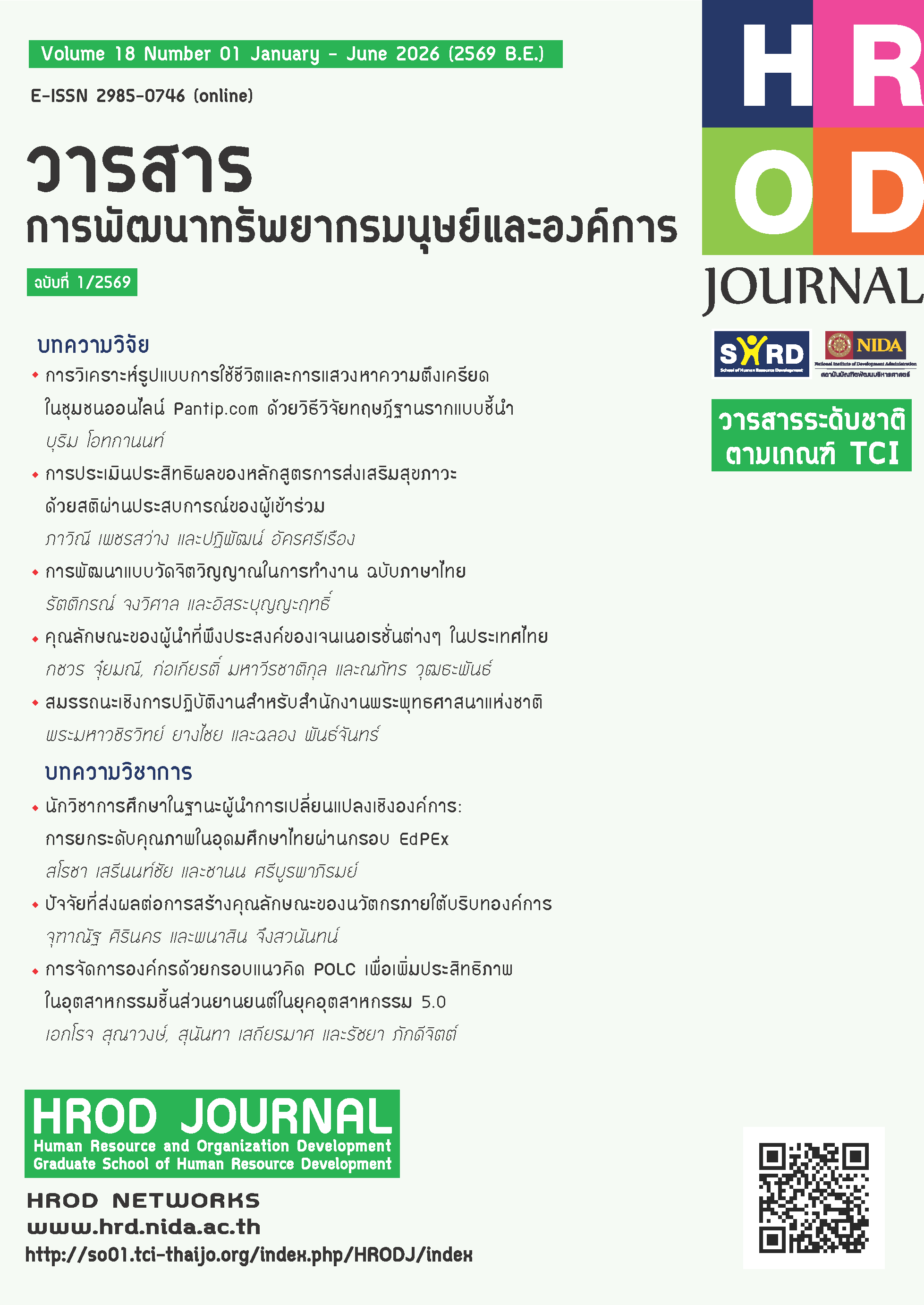
Preferred Leadership Characteristics among Different Generations in Thailand
Article Sidebar
Main Article Content
Abstract
The success of organizations depends on leaders who are ready to encounter management challenges and who can support employees from Generations X, Y, and Z, who hold different values and behaviors, to work together effectively. Some studies suggest that different generations clearly prefer different leadership characteristics. However, other research indicates that different generations do not differ in their preferences for leadership characteristics. This study aimed to examine the quality of the leadership preferences survey and to compare the leadership preferences of employees across generations. The sample consisted of 404 Thai employees aged 18–60 years, who had work experience and were paid employees. The results showed that the survey met acceptable standards of content validity, construct validity, convergent validity, and internal consistency reliability. Furthermore, it was found that Generation X statistically significantly preferred transformational leadership over authentic, servant, and inclusive leadership. In contrast, the preferences among the four leadership styles of Generations Y and Z showed no statistically significant differences. These findings can help managers adjust their leadership approaches to better suit the needs of employees in different generations. Furthermore, human resource departments can design leadership development programs that more effectively meet the expectations of employees across generations.
Article Details

This work is licensed under a Creative Commons Attribution-NonCommercial-NoDerivatives 4.0 International License.
1) The content of article in HROD journal is the author’s wholly responsibility to research, analyze, summarize, compile, and reference data. The editorial department will not be responsible in anyway.
2) The submitted articles in HROD journal must be unpublished before and must not be currently under consideration for publication elsewhere. If it is detected for its repetition, the author must be responsible for infringement of copyright.
3) Authors will be asked to transfer copyright of the article to the Publisher. The article is prohibited to reproduce all or part of the text, unless allowed.
References
กรมสุขภาพจิต. (2563, 24 กันยายน). Gen Y/Gen Me ประชากรกลุ่มใหญ่ของโลกยุคดิจิตอล ผู้กุมชะตาโลกในอนาคต. https://dmh.go.th/news/view.asp?id=1251
กิตติกวินท์ เอี่ยมวิริยาวัฒน์. (2565). ภาวะผู้นำแบบ Inclusive Leadership ต่อความสำเร็จในการประกอบธุรกิจช่วงสถานการณ์ COVID-19: กรณีศึกษาผู้ประกอบการวิสาหกิจขนาดกลางและขนาดย่อม จังหวัดบุรีรัมย์. วารสารศิลปศาสตร์และวิทยาการจัดการ, 6(2), 1–14. https://so02.tci-thaijo.org/index.php/journalfms-thaijo/article/view/259784
ชวิน ศิลาพันธ์ และ รัตติกรณ์ จงวิศาล. (2564). อิทธิพลของทุนทางจิตวิทยา ภาวะผู้นำที่แท้จริง และจิตวิญญาณในสถานที่ทำงานที่มีต่อความร่วมมือของข้าราชการกรมราชทัณฑ์ในเรือนจำพิเศษในเขตกรุงเทพมหานคร. มนุษยศาสตร์สาร, 22(2), 95–114. https://so03.tci-thaijo.org/index.php/JHUMANS/article/view/246919
เดชา เดชะวัฒนไพศาล, กฤษยา นุ่มพยา, จีราภา นวลลักษณ์ และ ชนพัฒน์ ปลื้มบุญ. (2557). การศึกษาเจนเนอเรชั่นเอ็กซ์และเจนเนอเรชั่นวายในมุมมองต่อคุณลักษณะของตนเองและความคาดหวังต่อคุณลักษณะของเจนเนอเรชั่นอื่น. จุฬาลงกรณ์ธุรกิจปริทัศน์, 36(141), 1–17. https://so01.tci-thaijo.org/index.php/CBSReview/article/view/22362
ทศพล กระต่ายน้อย. (2555). ภาวะผู้นำของนักศึกษาสายสังคมศาสตร์ มหาวิทยาลัยเชียงใหม่ [การค้นคว้าแบบอิสระปริญญามหาบัณฑิต, มหาวิทยาลัยเชียงใหม่]. บัณฑิตวิทยาลัย มหาวิทยาลัยเชียงใหม่. https://cmudc.library.cmu.ac.th/frontend/Info/item/dc:117472
ธมลวรรณ มีเหมย, รัตติกรณ์ จงวิศาล, และ ไฉไล ศักดิวรพงศ์. (2554). ภาวะผู้นำแบบผู้รับใช้ จิตวิญญาณในองค์การ ที่ส่งผลต่อผลการปฏิบัติงานของผู้บริหารระดับต้น ธุรกิจอุตสาหกรรมอาหารแห่งหนึ่งในเขตกรุงเทพมหานคร. วารสารวิชาการพระจอมเกล้าพระนครเหนือ, 21(2). https://ph01.tci-thaijo.org/index.php/kmutnb-journal/article/view/3751
นุช สัทธาฉัตรมงคล และ อรรถพล ธรรมไพบูลย์. (2559). ผู้นำการเปลี่ยนแปลงในยุคโลกาภิวัตน์สู่การพัฒนาอย่างยั่งยืน. วารสารธุรกิจปริทัศน์, 8(1), 167–182.
พนิดา ไชยแก้ว. (2559). อิทธิพลภาวะผู้นำของ Generation Y ต่อความสำเร็จทางธุรกิจ: กรณีศึกษาผู้ประกอบการกลุ่ม Generation Y ในประเทศไทย [วิทยานิพนธ์ปริญญาบริหารธุรกิจมหาบัณฑิต]. มหาวิทยาลัยธรรมศาสตร์.
มนัสวี ศรีนนท์. (2561). ทฤษฎีเจเนอเรชันกับกรอบวิธีคิด. จุลสารนวัตกรรม สถาบันนวัตกรรมการเรียนรู้ มหาวิทยาลัยมหิดล, 12(46), 2–3.
ไฮไลท์ประชาชาติ. (2568, 7 มีนาคม). แบ่งกลุ่ม 63 ล้านประชากรไทย แต่ละเจนต่างกันยังไง คนรุ่นไหนใหม่-เก่า? ประชาชาติธุรกิจออนไลน์. https://www.prachachat.net/hilight-prachachat/news-1768310
Ackerman, C. E. (2019, April 8). Positive leadership: 30 must-have traits and skills. PositivePsychology.com. https://positivepsychology.com/positive-leadership/
Amornpipat, I., & Sorod, B. (2017). Development of Thai authentic leadership measure: An application in a military context. Journal of Community Development Research (Humanities and Social Sciences), 10(2), 11–24. https://www.journal.nu.ac.th/JCDR/article/view/1816
Andi, H. K. (2018). Leadership styles preference among millennials workforce. Malaysian Journal of Youth Studies, 19, 114–134.
Avolio, B. J., & Bass, B. M. (1995). Individual consideration viewed at multiple levels of analysis: A multi-level framework for examining the diffusion of transformational leadership. The Leadership Quarterly, 6(2), 199–218. https://doi.org/10.1016/1048-9843(95)90035-7
Bass, B. M., & Avolio, B. J. (1993). Transformational leadership and organizational culture. Public Administration Quarterly, 17(1), 112–121
Bourke, J. (2016, April 14). The six signature traits of inclusive leadership: Thriving in a diverse new world. Deloitte Insights. https://www.deloitte.com/us/en/insights/topics/talent/six-signature-traits-of-inclusive-leadership.html
Ceballos, S. D. (2017). A study of the differences in GLOBE leadership preferences between Baby Boomers, Generation X, and Millennials [Doctoral dissertation, Our Lady of the Lake University].
Clapp-Smith, R., Vogelgesang, G. R., & Avey, J. B. (2009). Authentic leadership and positive psychological capital: The mediating role of trust at the group level of analysis. Journal of Leadership & Organizational Studies, 15(3), 227–240. https://doi.org/10.1177/1548051808326596
De Meuse, K. P., & Mlodzik, K. J. (2010). A second look at generational differences in the workforce: Implications for HR and talent management. People & Strategy, 33(2), 50–58.
Giallonardo, L. M., Wong, C. A., & Iwasiw, C. L. (2010). Authentic leadership of preceptors: Predictor of new graduate nurses' work engagement and job satisfaction. Journal of Nursing Management, 18(8), 993–1003. https://doi.org/10.1111/j.1365-2834.2010.01126.x
Glass, A. (2007). Understanding generational differences for competitive success. Industrial and Commercial Training, 39(2), 98–103. https://doi.org/10.1108/00197850710732424
Greenleaf, R. K. (2002). Servant leadership: A journey into the nature of legitimate power and greatness (25th anniversary ed.). Paulist Press.
Hair, J. F., Black, W. C., Babin, B. J., & Anderson, R. E. (2010). Multivariate data analysis (7th ed.). Pearson.
Hall, T. L. (2012). Leadership style predilection of Baby Boomers, Generation X'ers, and Generation Y'ers [Doctoral dissertation, University of Maryland University College]. ProQuest Dissertations and Theses Global. https://www.proquest.com/openview/7ace18afcbaafdf18f8b27e8e2383e3a/1?pq-origsite=gscholar&cbl=18750
Huyler, D., Gomez, L., Rocco, T. S., & Plakhotnik, M. S. (2025). Leading different generational cohorts in the workplace: Focus on situational and inclusive leadership. New Horizons in Adult Education and Human Resource Development, 37(1), 6–19. https://doi.org/10.1177/19394225241297230
Lhuglham, W., & Pruetipibultham, O. (2024). Leadership preferences of Generation Z toward performance and retention in electronic manufacturing company. International Journal of Human Resource and Organization Development, 1(1), 1–21. https://so13.tci-thaijo.org/index.php/IJHROD/article/view/610
Liden, R. C., Wang, X., & Wang, Y. (2025). The evolution of leadership: Past insights, present trends, and future directions. Journal of Business Research, 186, 115036. https://doi.org/10.1016/j.jbusres.2024.115036
Lin, C. (2020). The effect of inclusive leadership on employee well-being: A case of XYZ bank in Yunnan, China. ABAC ODI Journal Vision. Action. Outcome, 7(2), 39–61.
Lussier, R. N., & Achua, C. F. (2015). Leadership: Theory, application, & skill development (6th ed.). Cengage Learning.
McGaha, K. K. (2018). An interpretive phenomenological study of America’s emerging workforce: Exploring Generation Z’s leadership preferences [Doctoral dissertation, University of Phoenix]. ProQuest Dissertations and Theses Global.
Nembhard, I. M., & Edmondson, A. C. (2006). Making it safe: The effects of leader inclusiveness and professional status on psychological safety and improvement efforts in health care teams. Journal of Organizational Behavior, 27(7), 941–966. https://doi.org/10.1002/job.413
Ramírez-Herrero, V., Ortiz-de-Urbina-Criado, M., & Medina-Merodio, J. A. (2024). Intergenerational leadership: A leadership style proposal for managing diversity and new technologies. Systems, 12(2), 50. https://doi.org/10.3390/systems12020050
Reisenwitz, T. H., & Iyer, R. (2009). Differences in Generation X and Generation Y: Implications for the organization and marketers. Marketing Management Journal, 19(2), 91–103.
Seemiller, C., & Grace, M. (2016). Generation Z goes to college. Jossey-Bass.
Seneechai, N. (2014). Preference leadership styles of Generation Y [Master’s thesis, Mahidol University]. CMMU Digital Archive. https://archive.cm.mahidol.ac.th/handle/123456789/621
Spears, L. C., & Lawrence, M. (2016). Practicing servant-leadership: Succeeding through trust, bravery, and forgiveness. John Wiley & Sons.
Tenney, M. (n.d.). The 4 positive leadership styles in business. https://businessleadershiptoday.com/what-are-the-4-leadership-styles-in-business/
University of Southern California Libraries. (2025, August 28). Business demography: Age. https://libguides.usc.edu/busdem/age
Walumbwa, F. O., Avolio, B. J., Gardner, W. L., Wernsing, T. S., & Peterson, S. J. (2008). Authentic leadership: Development and validation of a theory-based measure. Journal of Management, 34(1), 89–126. https://doi.org/10.1177/0149206307308913
Wuttaphan, N. (2023). Gamification mechanism and elements affecting gamification dynamics: A case of Generation Z in Thailand. Journal of Humanities and Social Sciences Nakhon Phanom University, 13(3), 35–48. https://so03.tci-thaijo.org/index.php/npuj/article/view/272737
Yasar, R. (2024). The relationship between leadership styles and employees’ motivation of Generation Z [Independent study, Master of Business Administration, Siam University]. https://e-research.siam.edu/kb/the-relationship-between-leadership-styles
